Dawn of Creation

Swayambhu Bhu Linga, Kwagdhar

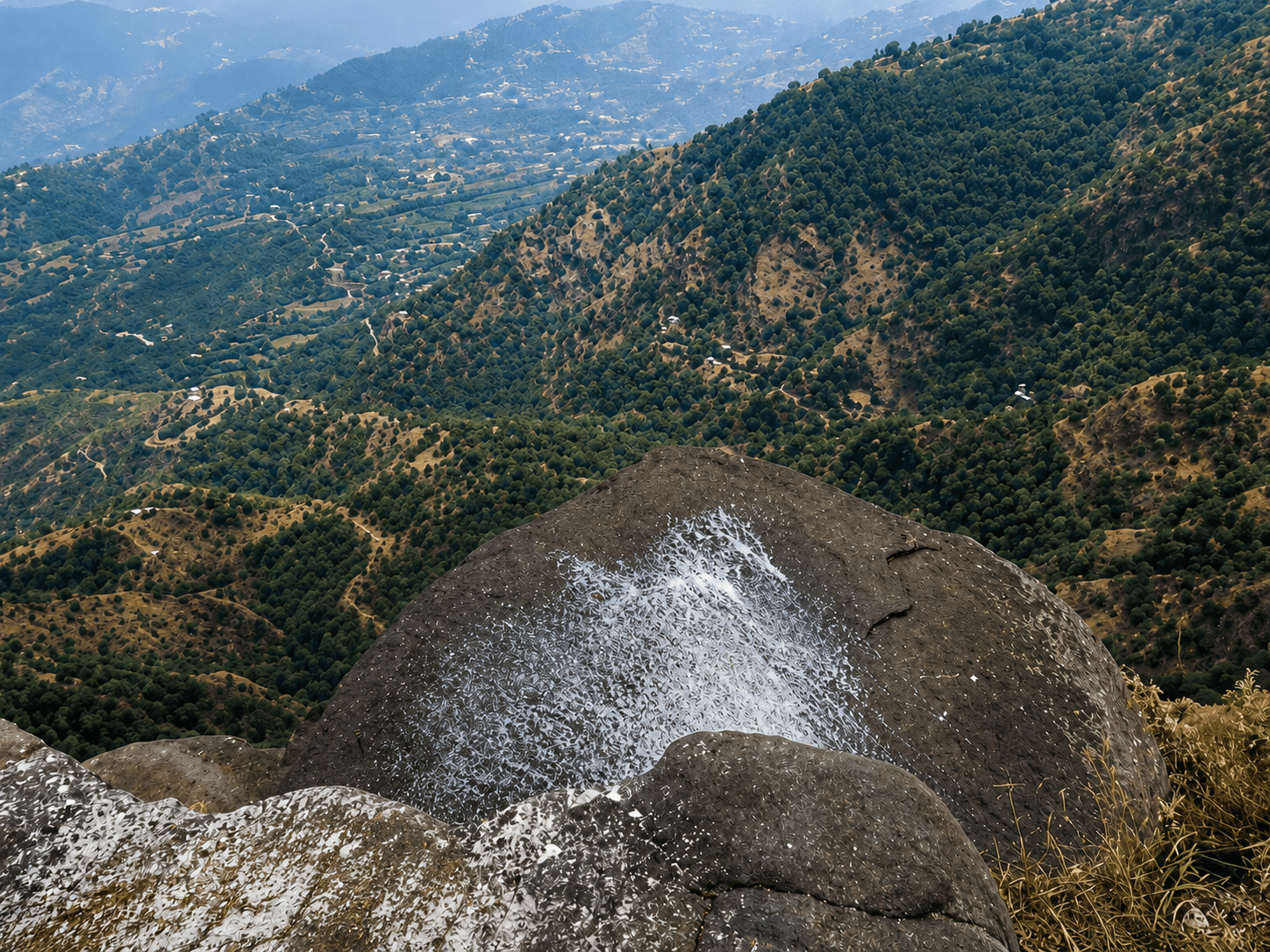
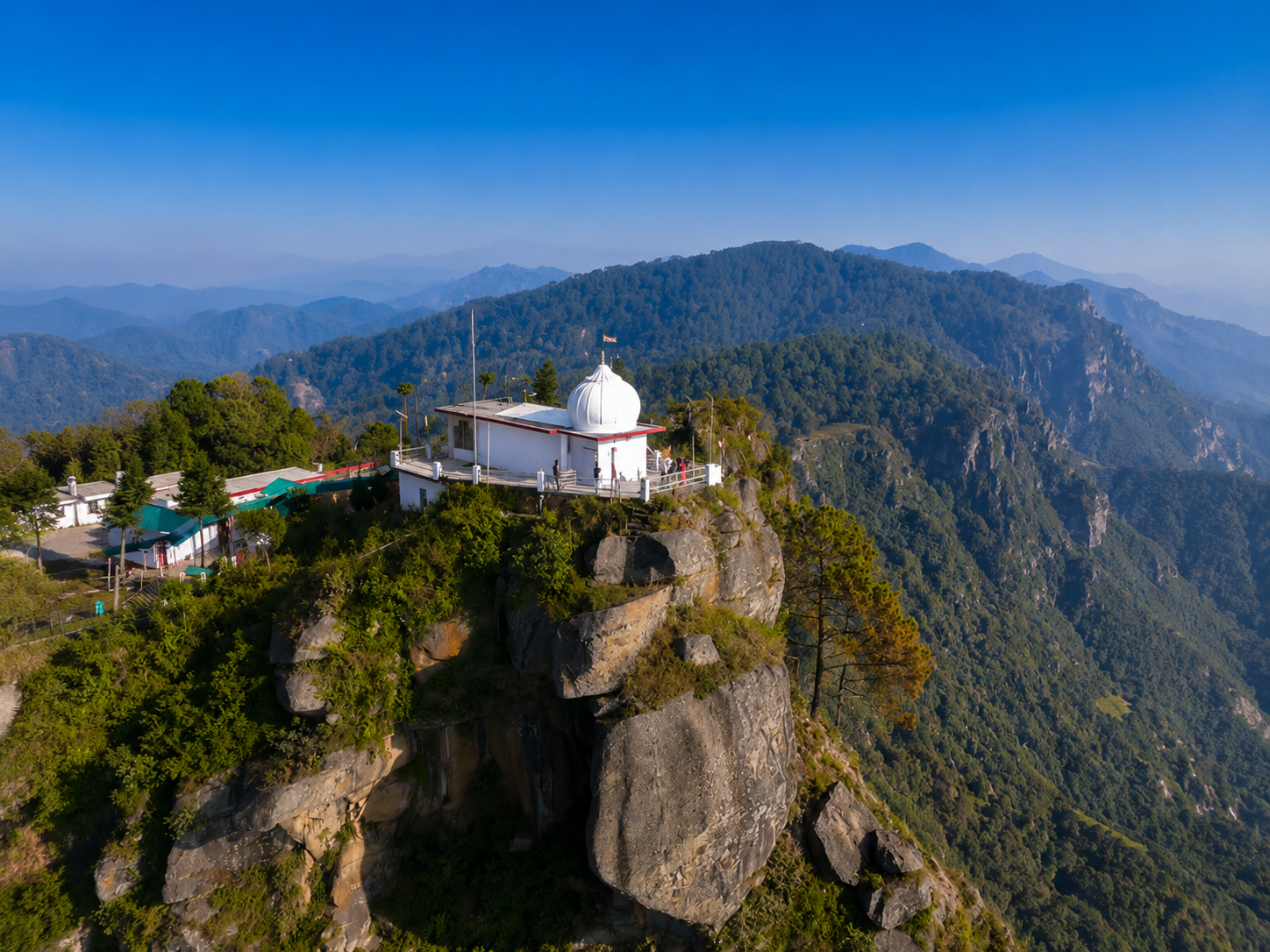
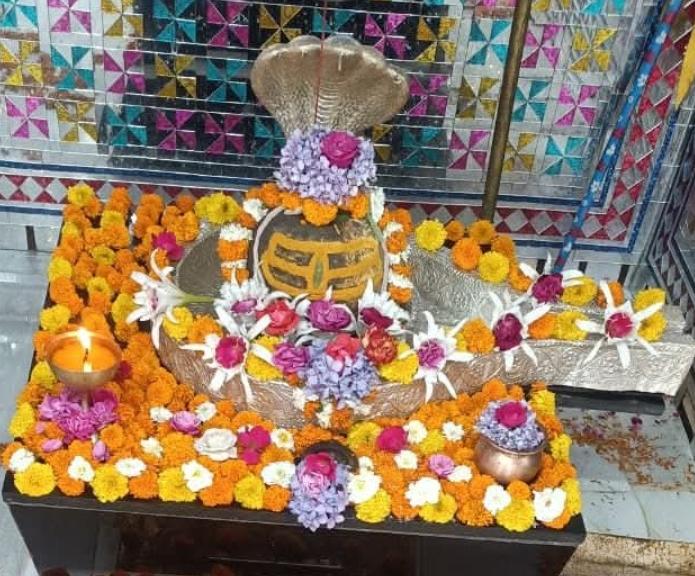
The most magnificent and spiritually significant core of the temple is the Swayambhu (self-manifested) Bhu Linga itself. Situated at the high peak of Kwagdhar, this primeval black Linga-shaped stone is uniquely positioned about 25 to 30 feet deep within the mountain's interior, alongside a special sacred rock (Shila Vishesh). According to the historical texts, this divine Linga has existed since the beginning of creation and was not crafted by any human hand, proving its primeval and natural origin. Local lore beautifully connects it to the Mahabharata era, describing how Lord Shiva assumed a divine form here to witness the great war of Kurukshetra. Because His divine shadow entered this very Linga, the deity came to be revered as "Bhureshwar Mahadev". Today, this majestic natural formation stands as the ultimate symbol of ancient devotion, worshipped and accessed only through highly specialized traditional protocols (Devling Vidhan).
Swayambhu Bhu Linga, Kwagdhar
Pre-1767 Era

Ancient Silver Ornaments - Trishul, Chhatra & Chanvar

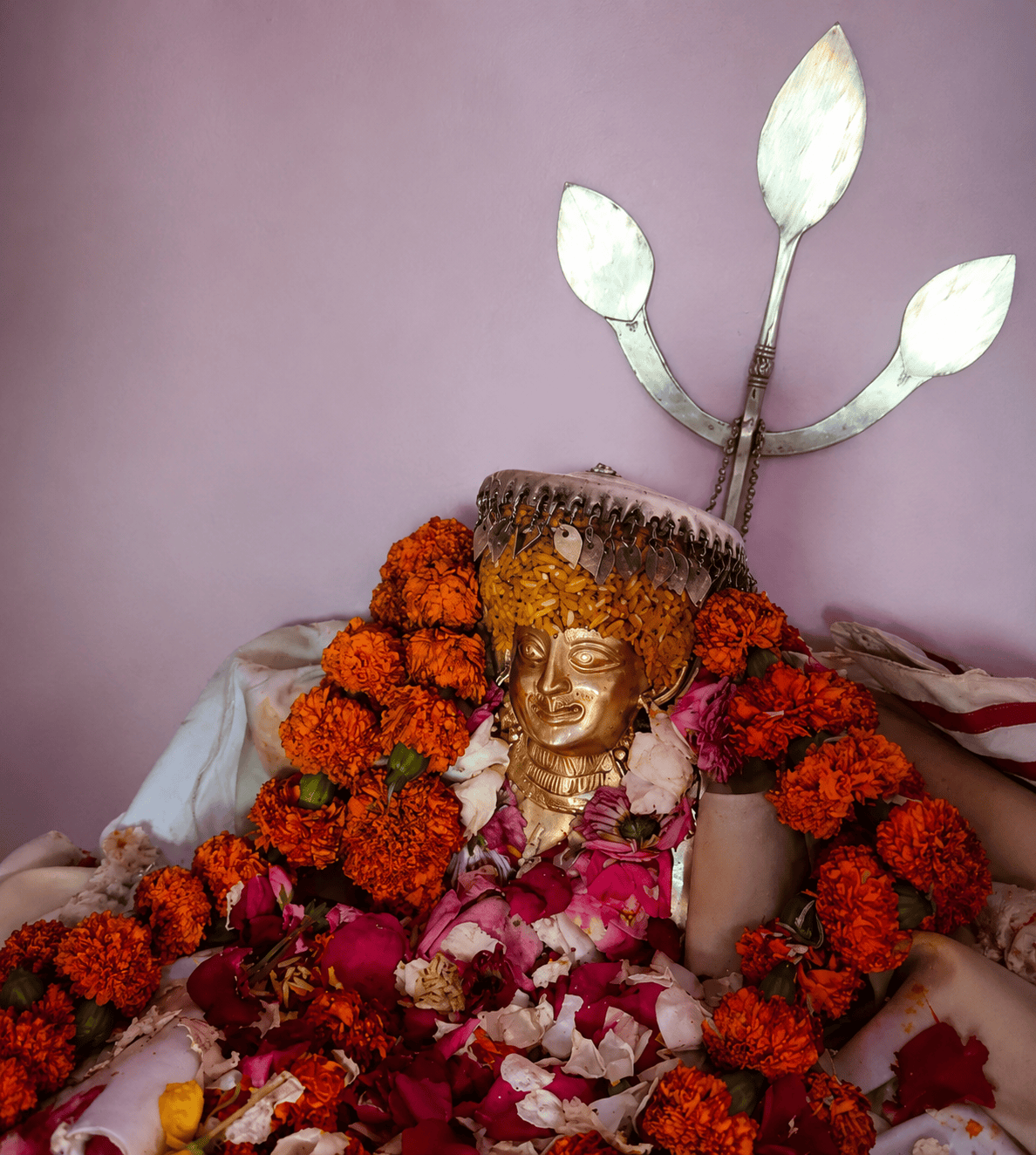
The ancient silver ornaments of Bhureshwar Mahadev, which include the sacred canopy (Chhatra), the fly-whisk (Chanvar), and the trident (Trishul), carry a profound history of devotion and survival. The invaders ruthlessly looted the temple's original gold and silver idols, as well as a magnificent silver palanquin (Palki). However, these specific silver ornaments were miraculously saved from the plunder. The survival of these artifacts traces back to a prior arrangement made by the ancestors of the hereditary priest (Muafidar Bahetmam), Padha Ram. Due to the harsh snowy conditions and the remote location of the hilltop temple, the priests had previously prayed to the deity, asking for permission to move the sacred items to their village, Pujarli, located about a 'kos' (a couple of miles) away, to ensure daily worship and security. Because these sacred silver ornaments were safely kept at the priest's residence in Pujarli rather than at the main temple, they entirely escaped the Gorkha loot.

Today, these very same surviving silver artifacts are adorned by the senior priest when he is possessed by the deity's power during sacred festivals and the divine procession (Dev Yatra) from the Pujarli base to the mountain temple.

Ancient Silver Ornaments - Trishul, Chhatra & Chanvar
Pre-1767 Era

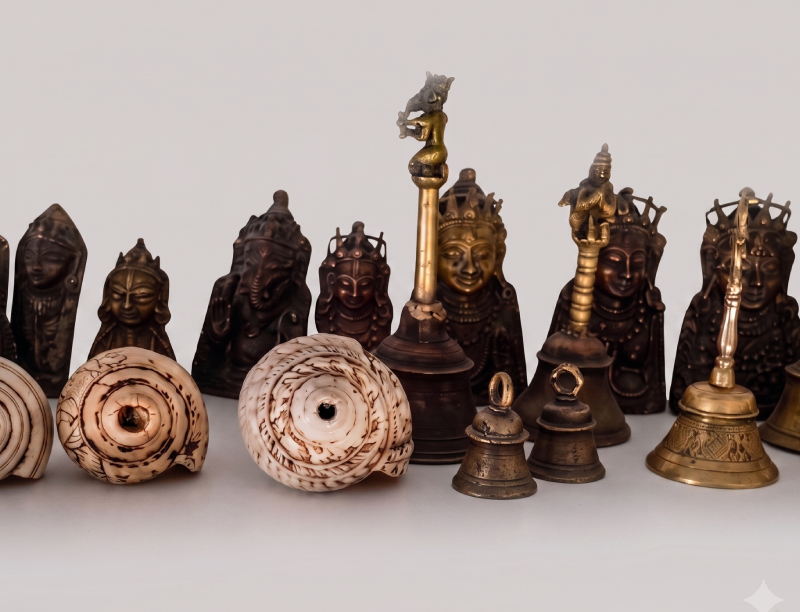
Ancient Metal Idols, Shankh and Ghantiyan

The history of the ancient metal idols, sacred conch shells (Shankh), and temple bells (Ghantiyan) is a remarkable tale of preservation during one of the most destructive periods for the Bhureshwar Mahadev temple. Despite this devastating loss, the temple's spiritual heritage was not completely erased. Along with the silver ornaments that had been safely moved to Pujarli village, several ancient idols made of Ashtadhatu (an eight-metal alloy), copper, and iron, as well as the traditional conch shells and bells, miraculously survived the invasion. The survival of these specific artifacts was entirely due to the quick thinking and devotion of the priests, who had kept them highly confidential and secretly hidden within the temple premises. Concealed from the eyes of the looters, these sacred metal idols, Shankh, and Ghantiyan were successfully saved and remain preserved today, standing as enduring symbols of the temple's resilience and the unwavering dedication of its guardians.

Ancient Metal Idols, Shankh and Ghantiyan
Historic Offering & Era

Traditional Musical Instruments & Silver Tumbadi

According to a fascinating local legend, devotees from the distant Jamli-Surla village once requested a symbol of the deity, as the main temple was located far away. Because divine protocols do not permit the construction of a new temple elsewhere, the priest provided them with small sacred stones representing Bhureshwar Mahadev, safely placed inside a simple dried gourd (Tumbadi). Over time, out of deep reverence, the devotees crafted a beautiful silver replica of this Tumbadi. Today, this sacred silver artifact is carried from house to house during local festivals, allowing every family to worship the deity and seek his divine blessings without having to make the arduous journey to the mountain peak.

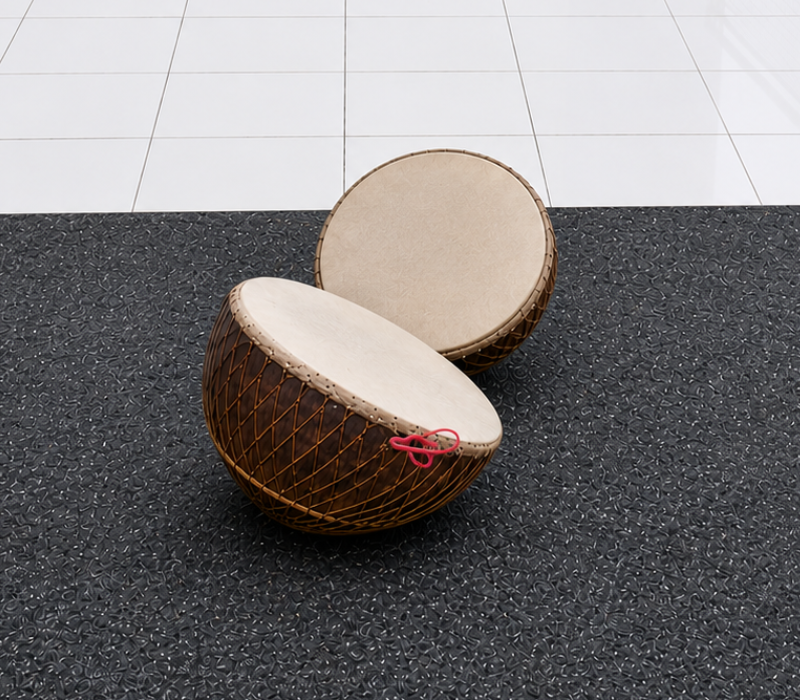
The traditional musical instruments of Bhureshwar Mahadev are an essential part of the deity's sacred rituals and divine processions. This historical collection includes several copper drums (Dhol), pairs of copper kettledrums (Nagada), traditional horns (Arnsingha), trumpets (Karnal), and the Shehnai. Today, these ancient instruments hold a profound spiritual purpose; they are played from a specific location during the deity's midnight rituals to signify to the anxious devotees that the sacred ceremonies are proceeding safely and auspiciously.

Traditional Musical Instruments & Silver Tumbadi
1768-1940 AD

Dev Shila & Pujasthali Pujarli

While not movable objects, the "Dev Shila" (also known as Tandav Shila) and the "Pujasthali" in Pujarli village are the most profound sacred heritage monuments of Bhureshwar Mahadev.The Dev Shila is a special sacred rock situated dangerously over a 6,800-foot-deep gorge, right behind the main Shivalinga. According to historical records, when Raja Brahm Prakash of Sirmour visited the temple, he witnessed a miraculous event: the senior priest, possessed by the deity and holding the sacred Trishul, Chhatra, and Chanvar, poured a stream of milk barefoot on this rock. Even today, during the midnight of the Dev Gyas and Dev Shayani festivals, the deity (through the priest) takes a divine leap onto this specific rock in complete darkness to bless the devotees and repeat ancient history.

Closely tied to this is Pujasthali Pujarli. Around the year 1768, due to heavy snowfall and the fear of theft at the isolated mountain peak, the priests prayed to the deity and relocated the sacred idols to their home in Pujarli village, about a 'kos' away. Later, around 1940, the revered Muafidar Mohatmim Bhuria Ram formally constructed the 'Pujasthali' here. This site is now the starting point of the divine procession (Dev Yatra). It is also the site of deep devotion where, on the night of Dev Gyas, holy ash ('Chhu') is prepared, and the priest's wife traditionally removes her symbols of marriage (suhag) until the deity safely returns from the perilous midnight leap at the Dev Shila.

Dev Shila & Pujasthali Pujarli
1876-1877 AD

Stone Jalhari from the 1876 rebuild

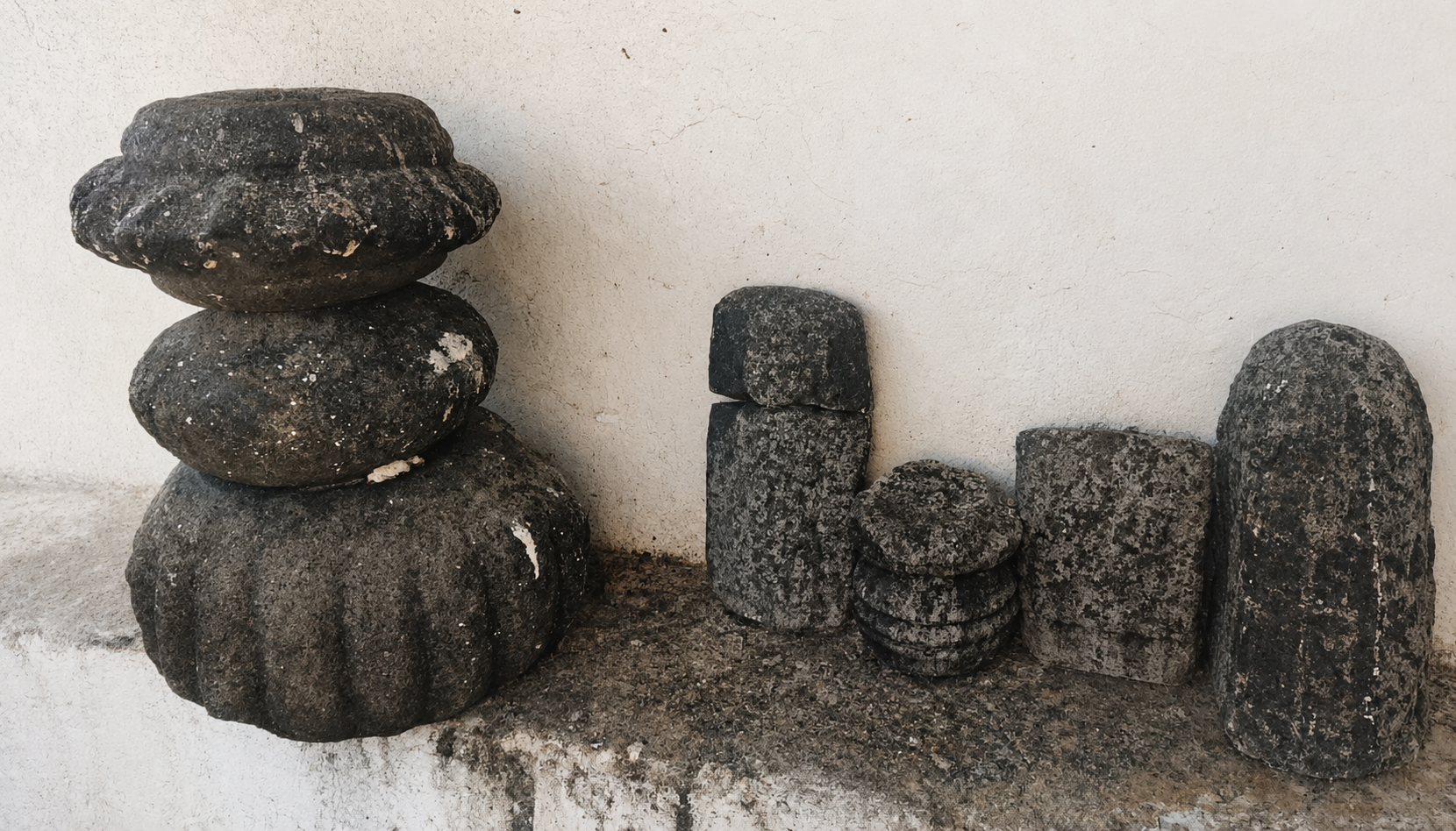
The 'Jalhari', which serves as the sacred base and water receptacle for the Shivalinga, holds a specific historical significance in the Bhureshwar Mahadev temple. According to the historical land settlement records of 1876-77, the temple had suffered significant damage over time, with its walls and roof having collapsed. During this period, under the tenure of the hereditary priest (Bahetmam) Padha Ram, a major restoration of the temple was undertaken. As part of this reconstruction, the sacred Jalhari was uniquely crafted by meticulously arranging fine, detailed stones around the exterior of the Linga. This stone-crafted artifact highlights the enduring dedication of the local caretakers to restore and preserve the holy sanctum for future generations.

Stone Jalhari from the 1876 rebuild
1876-1877 AD

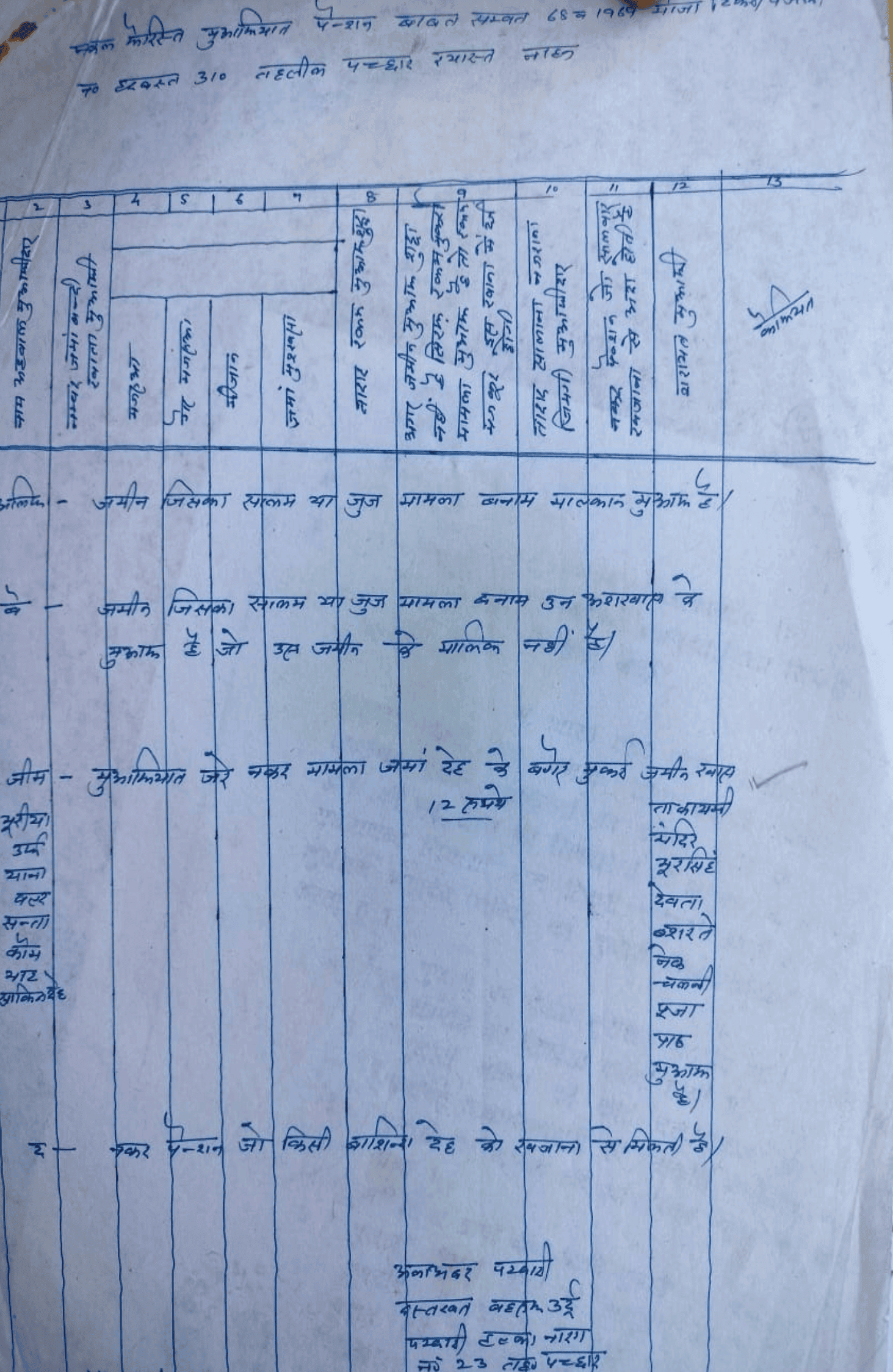
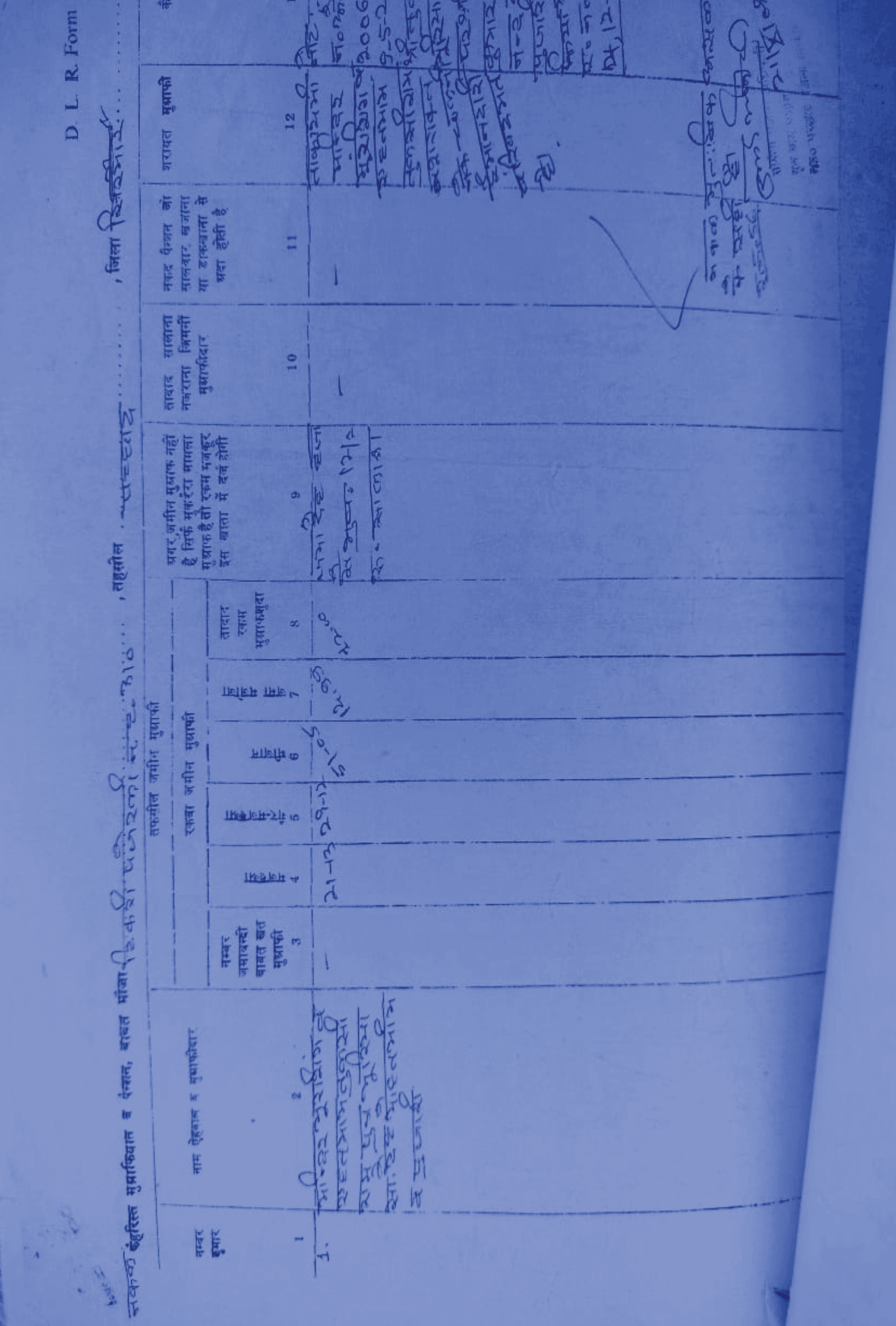
Misl Hakiyat & Fehrist Muafiyat

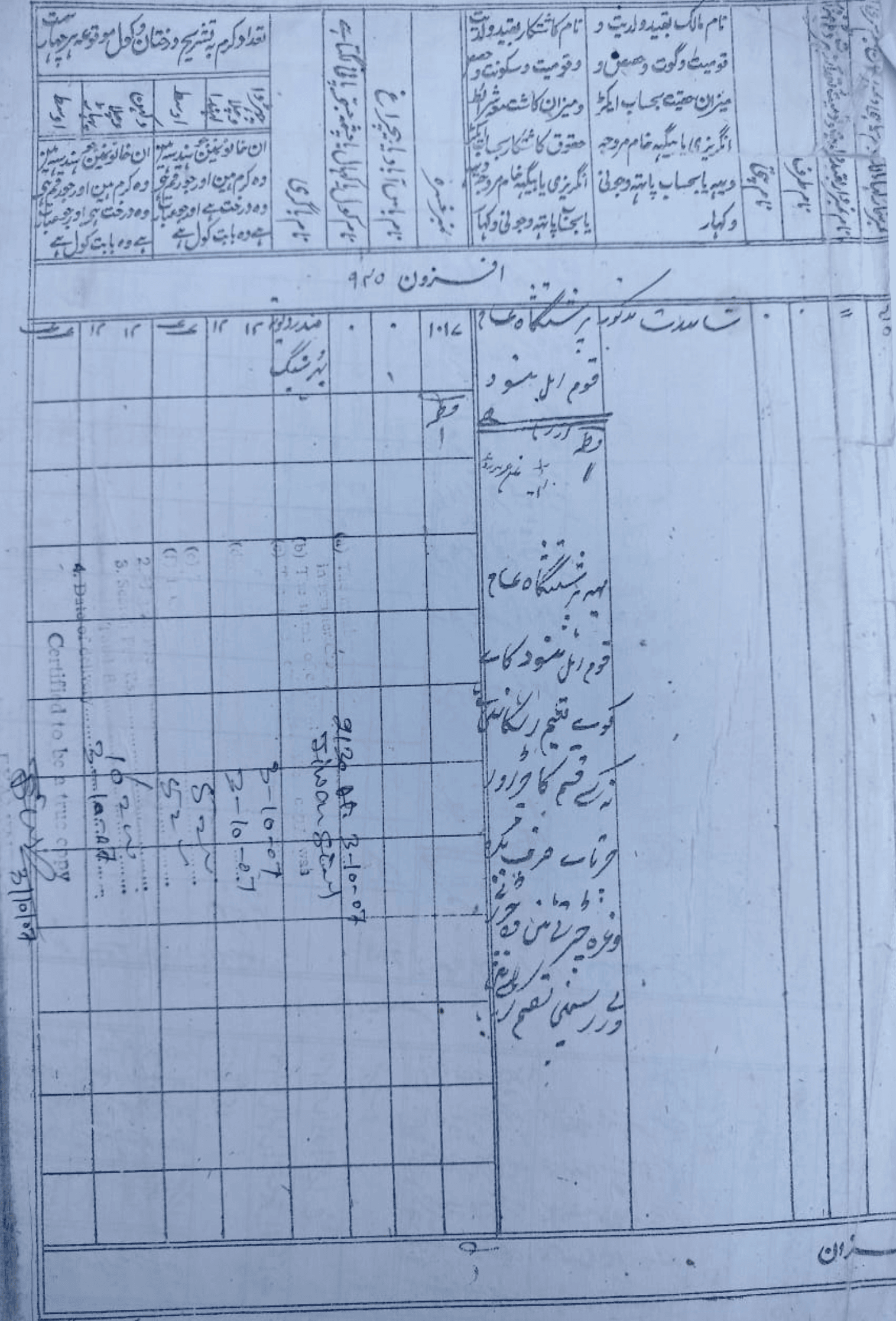
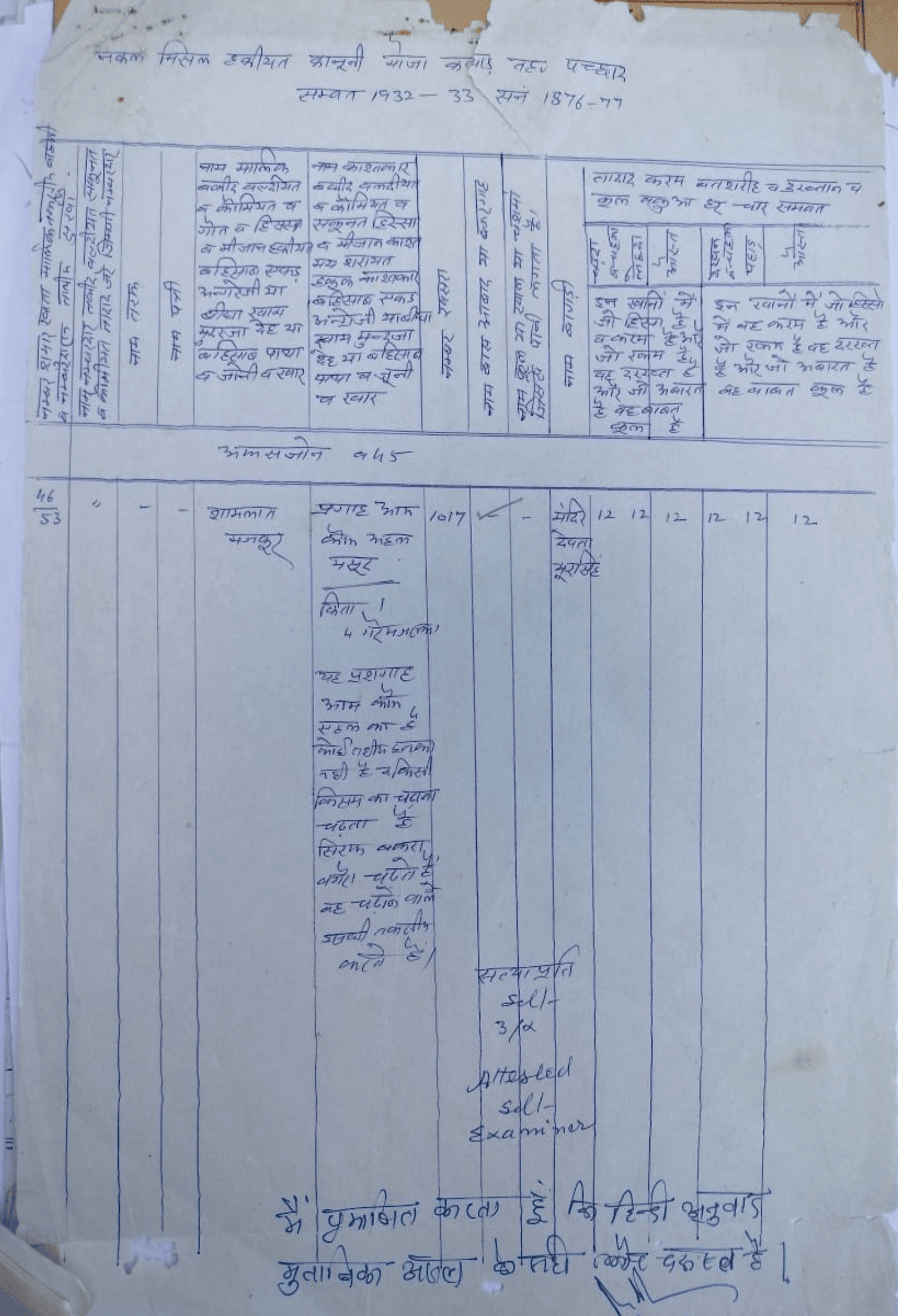
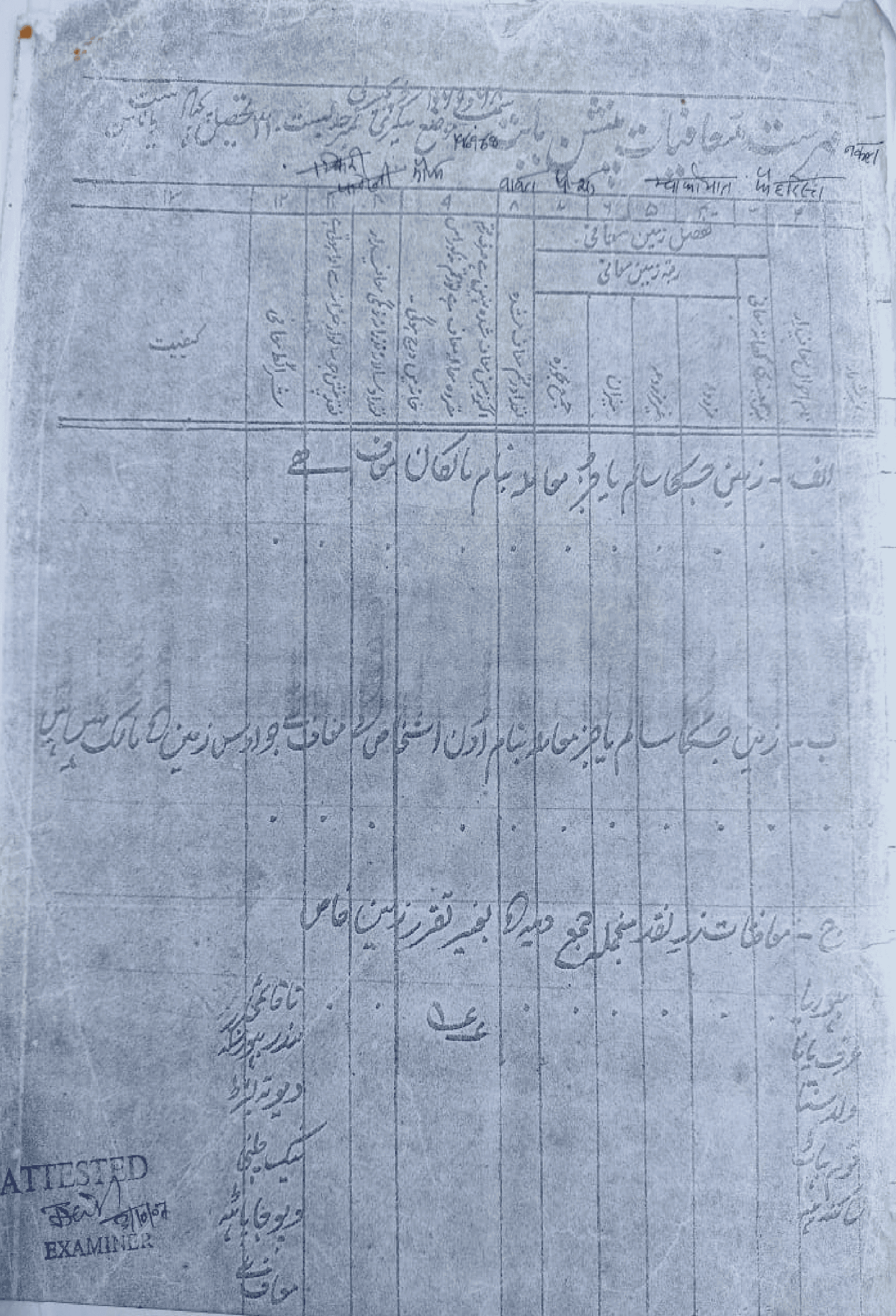
The "Misl Hakiyat" (Record of Rights) and "Fehrist Muafiyat" (Register of Revenue-Free Grants) are highly significant historical manuscript artifacts that validate the ancient legacy and royal patronage of the Bhureshwar Mahadev temple.

According to the Misl Hakiyat of 1876-77, the temple's physical existence is officially recorded on a 7-biswa plot of land under Khasra number 1017 in Moza Kathad.

Furthermore, the Fehrist Muafiyat and various royal Sanads (edicts) document a perpetual grant of 12 silver rupees provided by the Maharaja of Sirmour from the royal treasury. This special grant (Muafi) was strictly designated for the hereditary priests (Muafidar Mohatmim) to ensure uninterrupted daily rituals (dhup-deep), maintenance, and repairs of the temple. Bearing official stamps from the era of the Sirmour state and British administration, these preserved revenue manuscripts stand as tangible proof of the temple's unbroken spiritual administration and historical significance across centuries.

Misl Hakiyat & Fehrist Muafiyat
1934 AD

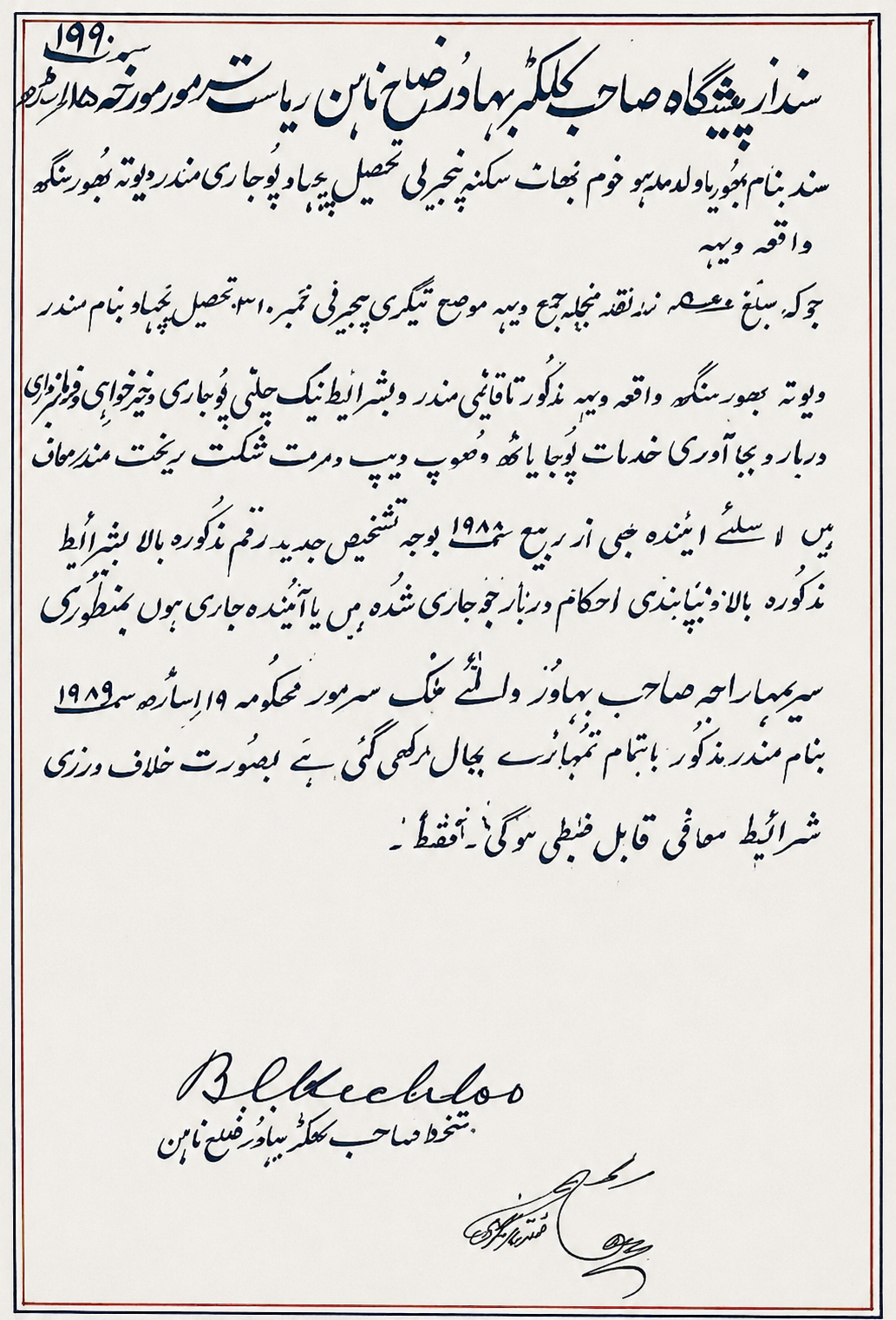
Sirmour State Sanad

The 'Sanad' (Royal Edict) of the Sirmour State is a prestigious manuscript and a vital historical artifact of the Bhureshwar Mahadev temple.

Issued on the 15th of Ashadh, Samvat 1990 (around 1934 AD) during the reign of the last ruler, Maharaja Rajendra Prakash, this official document was presented to the revered hereditary priest, Bhuria Ram, by Collector B.L. Kichloo.

The Sanad officially recognized and honored him with the title of 'Bahetmam' (manager and head priest) of the temple. Furthermore, it formalized the royal grant (Muafi) of 12 rupees, strictly designated for the temple's daily rituals (puja-path, dhup-deep) and structural maintenance (murammat). This beautifully preserved royal mandate reflects the deep reverence the Sirmour rulers held for the deity and their commitment to sustaining the temple's sacred traditions through its dedicated guardians.

Sirmour State Sanad
1934 AD

Priestly Bahi & Written Registers

The "Priestly Bahi" (traditional ledger) and written registers serve as invaluable manuscript artifacts that chronicle the internal administration and sacred inventory of the Bhureshwar Mahadev temple. During the British administrative era, the temple's records began to be systematically documented in writing. In the year 1934 AD (Samvat 1990), the revered hereditary priest (Muafidar Mohtamim), Bhuria Ram, meticulously rewrote and updated this ancestral family document, traditionally known as the "Bahi". This crucial manuscript recorded the intricate details of the temple's management and contained a signed, comprehensive inventory of all the sacred belongings and artifacts. Today, this treasured document stands as a remarkable testament to the transparency, devotion, and organized custodianship of the temple's historic guardians.

Priestly Bahi & Written Registers
1959 AD

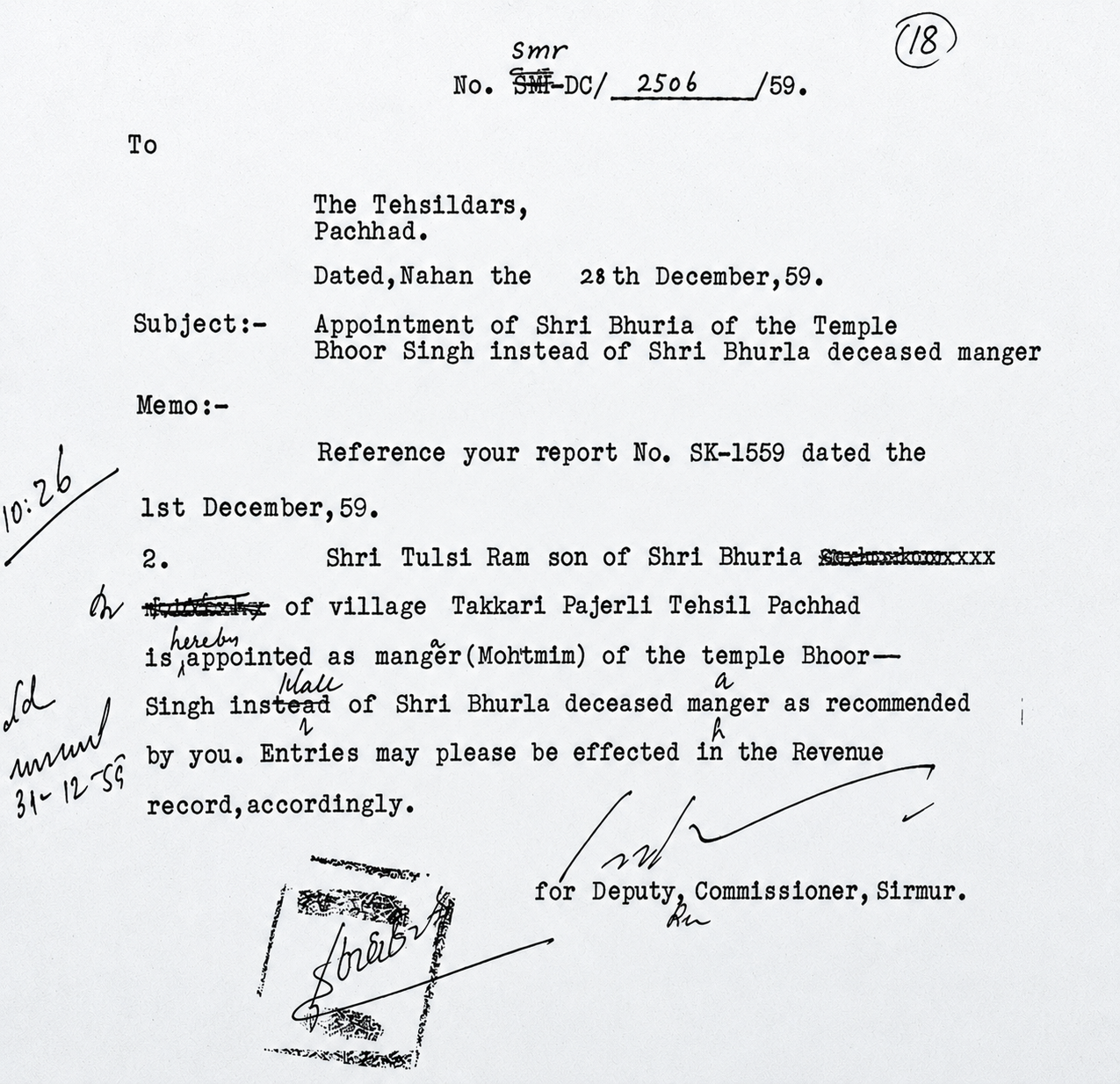
DC Order Appointing Tulsiram - 1959

The 1959 Deputy Commissioner (DC) Order is a crucial post-independence legal artifact that successfully safeguarded the temple's ancient hereditary administration. Following the demise of the long-serving priest Bhuria Ram in 1959, a familial dispute arose over the succession of the 'Bahetmam' (manager and head priest) title and the associated royal grant of 12 rupees. The District Collector of Sirmour thoroughly examined the traditional claims and dismissed the objections raised by another family member due to a lack of evidence. Consequently, an official order was issued on December 25, 1959, officially appointing Tulsi Ram (son of Bhuria Ram) as the rightful hereditary priest and Mohtamim, specifically recognizing his adherence to the perilous 'Shila Vishesh' traditions.

To prevent any future conflicts, this landmark administrative document permanently linked the temple's Muafi (grant) directly to the hereditary land records, ensuring that the spiritual legacy remained firmly protected in the hands of its rightful guardians.

DC Order Appointing Tulsiram - 1959

Location

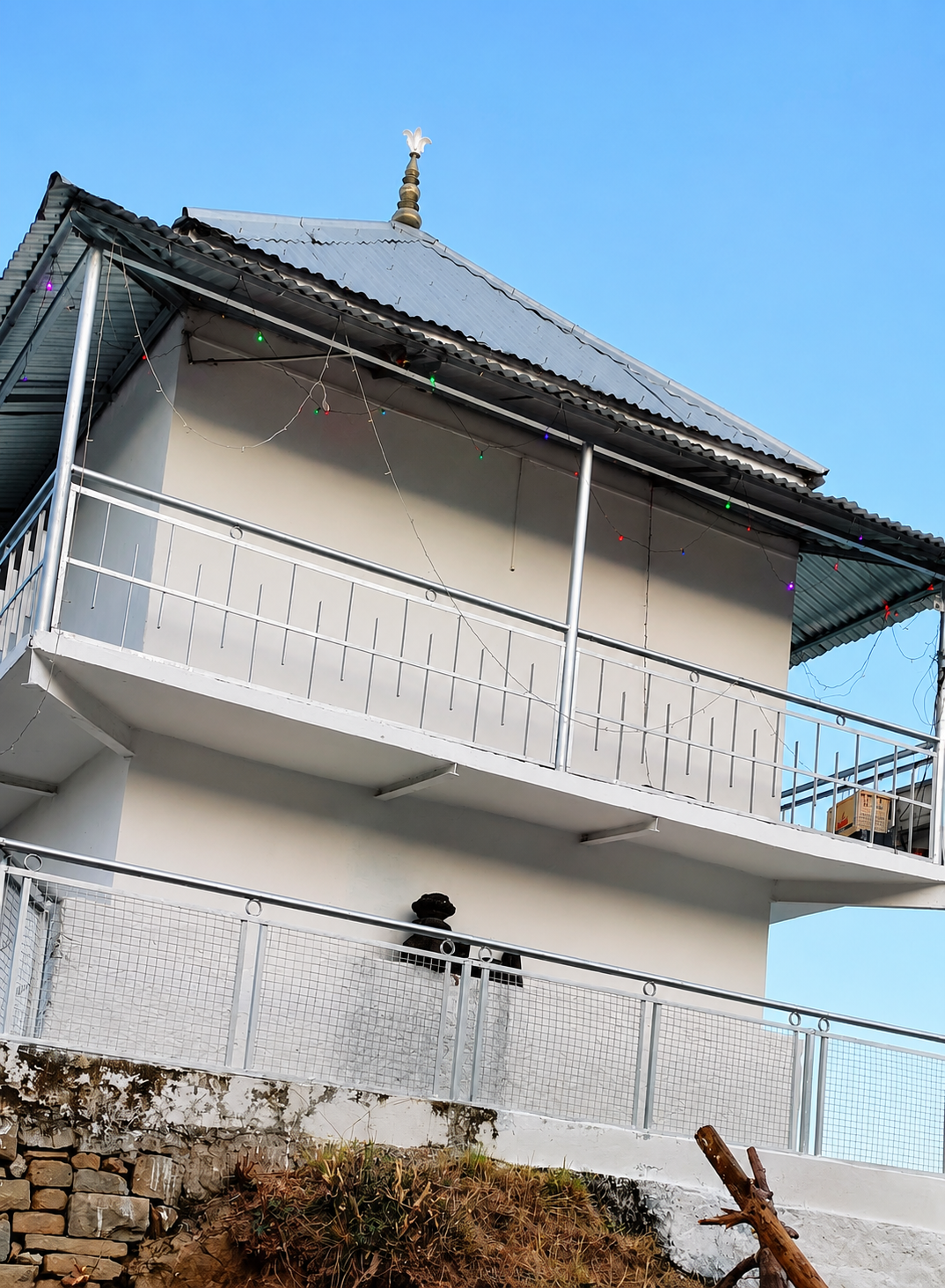
Bhureshwar Mahadev Temple, Kwagdhar, Sirmaur, H.P.

Temple Timings

Temple Open at Sunrise till Sunset

Photography

Photography allowed in designated areas only.

Visitor Guidelines

Please maintain silence and respect the sanctity of the place.